
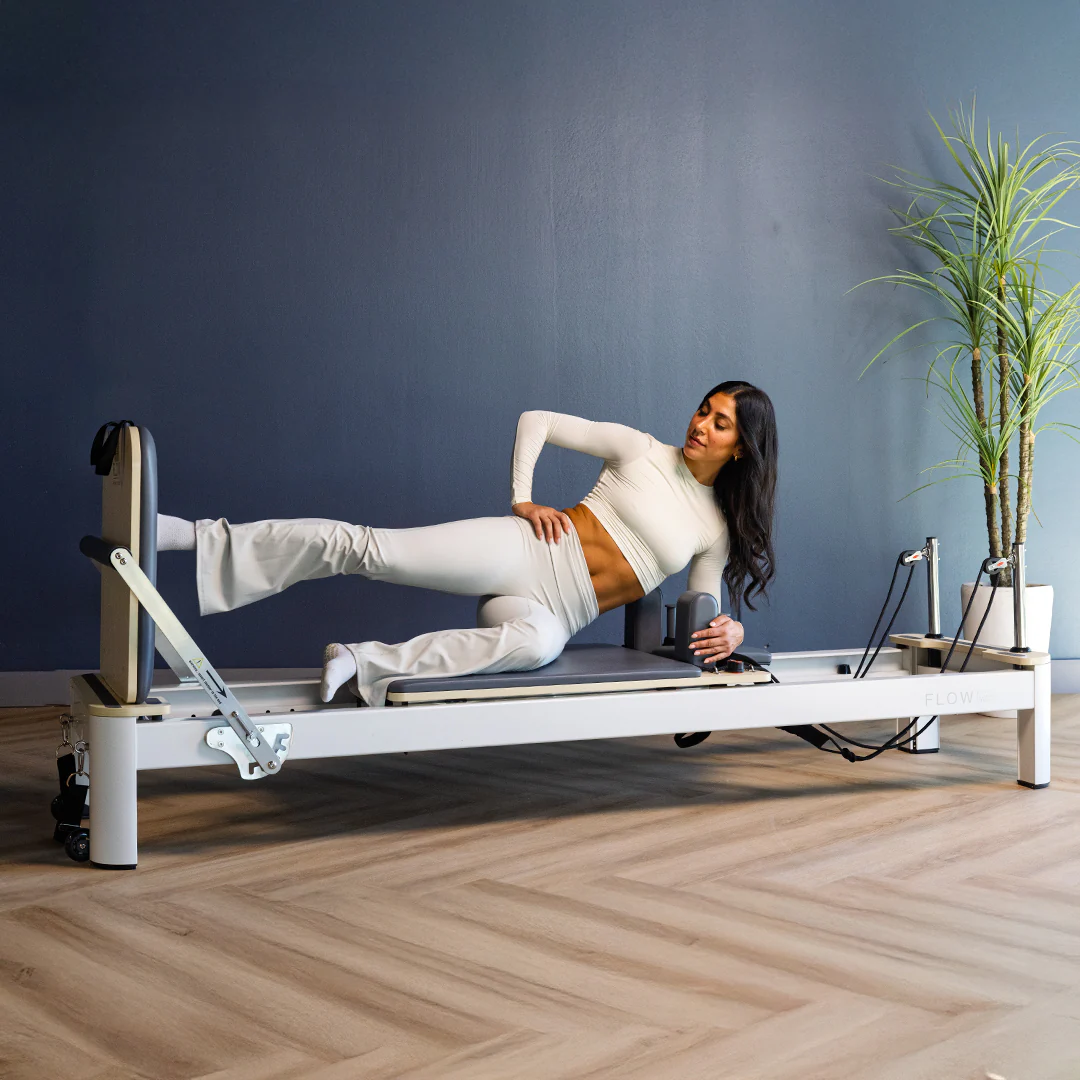
Over the past decade, I’ve worked with many women (busy professionals, new moms, postmenopausal clients and active twenty-somethings) who come to me with the same story: nagging aches, stiffness, or that deep fatigue that just won’t quit. What started as a simple add-on in my treatment plans has become one of my favourite clinical tools: the reformer.
Today I want to share why reformer Pilates has earned a permanent place in my practice, and the research that keeps me convinced it’s worth your time.
What makes the reformer different
Unlike mat Pilates, which relies on body weight alone, the reformer is a spring-loaded machine with an adjustable carriage that slides back and forth. This setup lets me tailor every exercise to your exact needs, whether you’re recovering from injury or simply want to move better. The movements are slow, controlled and precise, which is exactly what injured or deconditioned tissues need.
Because it’s low-impact, it’s gentle on joints while still building deep core strength, posture and stability. For women, whose bodies go through so many hormonal, postural and life-stage changes, this kind of controlled environment is invaluable.
“Once clients learn how to engage their deep core on the reformer, their backs stay happier, even when life gets hectic.”
Chronic low back pain
This is probably the complaint I see most often. A 2016 randomized controlled trial in postmenopausal women with chronic low back pain found that adding a six-week clinical Pilates program to standard physiotherapy produced significantly better results than physiotherapy alone. Pain and disability both improved, and the gains were still present at the one-year follow-up.[1]
A broader meta-analysis of Pilates-based exercise for persistent, non-specific low back pain found similar results: meaningful reductions in pain and functional disability compared with minimal care.[2] On the reformer, I can progress or regress each movement on the spot, which is ideal for women whose pain flares unpredictably or who are rebuilding confidence after a setback.
Neck pain and upper-back tension
Women who spend hours at computers or on their phones frequently come in with chronic neck pain. A pilot study showed that a six-week Pilates program significantly improved neck disability scores, with pain continuing to improve at the twelve-week mark.[3] These are changes large enough to affect daily life, like turning to check blind spots or lifting groceries without that familiar twinge.
On the reformer, we focus on shoulder blade stability and upper-back mobility in ways that mat work often can’t match. Clients regularly tell me they feel “taller and lighter” after just a few sessions.
Body composition: the result that surprises people
Many women assume Pilates is only about flexibility. But in a 16-week reformer program for active women returning after a break from exercise, skinfold measurements dropped, waist-to-hip ratio improved and muscle mass increased, without drastic diet changes or high-impact training.[4] Mat Pilates has also been studied for body composition in older women.[5]
The reformer adds precise resistance, so my clients in their fifties and sixties can rebuild strength safely and see visible, confidence-boosting changes in their posture and shape.
Fibromyalgia
The gentle, mindful nature of reformer work can feel like a lifeline for women living with fibromyalgia. A pilot study found that 12 weeks of Pilates training reduced pain and improved function more than a home stretching and relaxation program.[6] Many of my clients describe it this way too: the breathing, the controlled flow and the focus on alignment calm the nervous system while strengthening the muscles that support everyday tasks. Because I can adjust the springs to meet them on any given day, we avoid the boom-and-bust cycle that so often follows other exercise attempts.
Posture and scoliosis
I see many young women and students with mild non-structural spinal curves that cause both pain and self-consciousness. One study in female college students found that Pilates reduced the degree of non-structural scoliosis, improved trunk flexibility and reduced pain.[7] On the reformer, side-bending and rotation can be performed in a supported way that gently lengthens tight muscles while strengthening the weaker side.
Pelvic health
Whether you’re postpartum, perimenopausal or just noticing leaks when you laugh, pelvic health is something every woman deserves to think about. A randomized clinical trial found that a Pilates exercise program improved pelvic floor muscle strength about as effectively as traditional pelvic floor muscle training.[8] I love using the footwork and bridging variations on the reformer for this, and many clients tell me they finally “feel” their pelvic floor working again after just a handful of sessions.
Part of a real physiotherapy plan
What I appreciate most is how the reformer fits into a true treatment plan rather than sitting apart from it. I don’t hand clients a generic class schedule. I assess their movement patterns, strength and goals first, then use the reformer as the bridge to get them back to running, lifting toddlers, or simply sitting at a desk without pain.
Not every study I’ve cited is large-scale (many are pilot trials), but the pattern is consistent: clinical Pilates can improve pain, function, body composition and confidence. As a physiotherapist, I’m always looking for interventions that are safe, adaptable and empowering. This one checks every box.
References
- Cruz-Díaz D, Martínez-Amat A, Osuna-Pérez MC, De la Torre-Cruz MJ, Hita-Contreras F. Short- and long-term effects of a six-week clinical Pilates program in addition to physical therapy on postmenopausal women with chronic low back pain: a randomized controlled trial. Disabil Rehabil. 2016;38(13):1300-1308. doi:10.3109/09638288.2015.1090485
- Aladro-Gonzalvo AR, Araya-Vargas GA, Machado-Díaz M, Salazar-Rojas W. Pilates-based exercise for persistent, non-specific low back pain and associated functional disability: a meta-analysis with meta-regression. J Bodyw Mov Ther. 2013;17(1):125-136. PubMed
- Mallin G, Murphy S. The effectiveness of a 6-week Pilates programme on outcome measures in a population of chronic neck pain patients: a pilot study. J Bodyw Mov Ther. 2013;17(3):376-384. PubMed
- Vaquero-Cristóbal R, Alacid F, Esparza-Ros F, López-Plaza D, Muyor JM, López-Miñarro PA. The effects of a reformer Pilates program on body composition and morphological characteristics in active women after a detraining period. Women Health. 2016;56(7):784-806. doi:10.1080/03630242.2015.1118723
- Fourie M, Gildenhuys GM, Shaw I, Shaw BS, Toriola AL, Goon DT. Effects of a mat Pilates programme on body composition in elderly women. West Indian Med J. 2013;62(6):524-528. PubMed
- Altan L, Korkmaz N, Bingol U, Gunay B. Effect of Pilates training on people with fibromyalgia syndrome: a pilot study. Arch Phys Med Rehabil. 2009;90(12):1983-1988. PubMed
- Alves de Araújo ME, Bezerra da Silva E, Bragade Mello D, Cader SA, Shiguemi Inoue Salgado A, Dantas EH. The effectiveness of the Pilates method: reducing the degree of non-structural scoliosis, and improving flexibility and pain in female college students. J Bodyw Mov Ther. 2012;16(2):191-198. PubMed
- Culligan PJ, Scherer J, Dyer K, et al. A randomized clinical trial comparing pelvic floor muscle training to a Pilates exercise program for improving pelvic muscle strength. Int Urogynecol J. 2010;21(4):401-408. doi:10.1007/s00192-009-1046-z