
Originally published on November 1, 2022 by Vital Physiotherapy & Wellness, now part of the Bravella Health network. Original author: Talia Diamond.
By: Talia Diamond, Pelvic Health Physiotherapist
Something we often hear from clients who have delivered via Cesarean is: “I didn’t have a vaginal delivery, so that must mean that nothing has changed with my pelvic floor and I don‘t need to see a pelvic floor physiotherapist!”
Unfortunately, this is a myth! A Cesarean birth doesn’t mean your pelvic floor hasn’t been ‘changed’ or impacted, and someone who is postpartum (once you have a baby you are always postpartum…) should see a pelvic physiotherapist regardless of the method of delivery. This is my personal opinion as a pelvic physiotherapist, and I’ll share why!
First of all, someone who has birthed via Cesarean was still pregnant!
Many of the changes to the pelvic floor, and body as a whole, are related to pregnancy, regardless of the method of delivery. Pregnancy requires the pelvic floor muscles to work harder to support the pelvic organs and growing baby for 9 months, and the abdominal wall stretches to make room for the growing baby.[1]
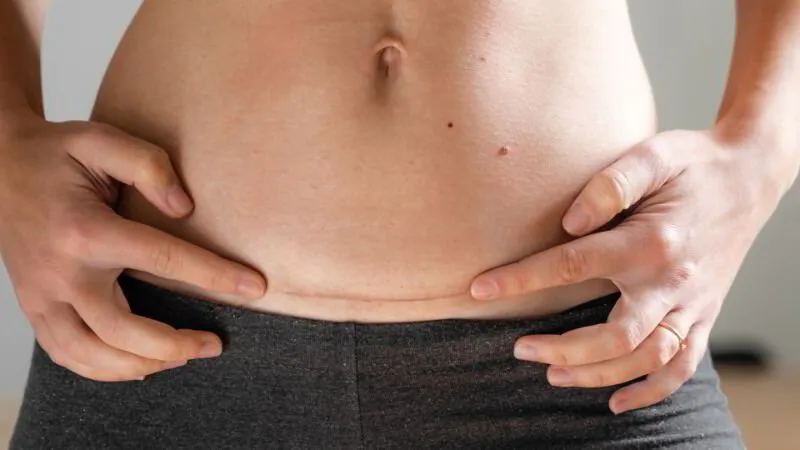
Second, a Cesarean section is major abdominal surgery and several incisions are made through various depths of tissue that once fully healed, would benefit from stretching and massaging to help them regain full mobility and flexibility.[2,4]
Cesarean sections are not always planned, and are often urgent or emergency procedures which means that prior to the Cesarean, women still go through labour, and potentially some stages of pushing which can still impact the pelvic floor muscles and other surrounding tissues. However, even if they haven’t gone through labour and pushing, pregnancy itself affects the pelvic floor.[1]
To give you a clearer idea of the role pelvic physiotherapist can play post Cesarean birth, here are the 3 main reasons to see a pelvic floor physiotherapist:
Core Weakness/Lack of Core awareness
Return to exercise postpartum in a healthy manner takes both time and effort, due to all the physical changes that your body goes through during pregnancy and birth, and after birth.
A cesarean birth specifically, which as mentioned above, is major abdominal surgery, which cuts through the fascia (tissue) surrounding the major abdominal muscles, including the transversus abdominis, the deepest core muscle. A Cesarean adds to the weakness in core muscles due to the invasiveness of the abdominal surgery.
This muscle is an important part of the core, along with the pelvic floor and diaphragm (breathing muscle) and is necessary for pressure management in our body, and stabilizing our body, which is especially relevant during functional tasks, such as lifting and carrying baby, and is often difficult to access/activate following birth due to the surgery itself, and the stretch it sustains during pregnancy.[3]
There are two incisions made (not just the outer, visual ‘skin scar’ that you see!) And even though none of the incisions go through the abdominal muscles, it does cut through the tissue that surrounds the major abdominal muscles, allowing the surgeon to pull the abdominal muscles apart to continue towards baby.
A pelvic physiotherapist will assess the function and engagement of the abdominal muscles and help re-train their activation and strength.
Scar tissue
Increased adhesions, tightness and restrictions along the Cesarean scar, as well as above and below the visual scar (remember when I mentioned there were two incisions?) adnd pain and soreness in these areas is very common.[5] The ‘go ahead’ to work on the scar tissue is generally at 6 weeks postpartum, but this tissue can take a lot longer to heal, as 6-8 weeks post- surgery is just the initial healing time.[4]
There is often numbness, or lack of sensation felt around the incision for several weeks to months post surgery
A pelvic Physiotherapist can help will scar massage/release to improve tissue mobility (and teach this for ‘homework’) and find helpful massages and exercises in order to assist with strength and mobility to the area.[4,5]
As well, an exercise program would be put together that is appropriate for any current restrictions/limitations due to tissue limitations.
Low back pain:
Physiotherapy following a caesarean section is important because it can minimize the risk of low back pain by improving posture and the support to the lower back, which includes the core system.[6]
As mentioned above, core weakness is extremely common during pregnancy, and postpartum, especially post-Cesarean due to the increased loads and demands on ones body to care for a baby, all while healing from major surgery! A baby needs to be fed, and changed, lifted and carried, rocked, no matter any current movement limitations from their parent.
Not to mention that the core is not functioning 100% due to its impact during the surgery. One of the main functions of the ‘core 4’, is to stabilize our spine, hold us upright against gravity, and manage pressures in our body, in order to prevent injury.[3] When these muscles are not working 100%, other muscle groups need to come on to help with this, and compensate. In addition, mobility and lifting are somewhat restricted for the first 6 weeks, which can also limit how we move, and how much we move.
Pelvic health physiotherapists can help teach you proper exercises to ensure you don’t experience any lower back.
I do want to stress that there are many other symptoms one can experience post- cesarean and that are related to pelvic floor muscle changes. This includes incontinence (leakage), painful intercourse and pelvic pain, to name a few additional symptoms not noted above.[7,8] With that being said, everyone who is postpartum can benefit from seeing a pelvic floor physiotherapist to help alleviate any pain, tissue restrictions, core strengthening and return to exercise, and return to intercourse.
By: Talia Diamond, Pelvic Health Physiotherapist
References
- Hage-Fransen MAH, Wiezer M, Otto A, et al. Pregnancy- and obstetric-related risk factors for urinary incontinence, fecal incontinence, or pelvic organ prolapse later in life: a systematic review and meta-analysis. Acta Obstet Gynecol Scand. 2021;100(3):373-382. doi:10.1111/aogs.14027
- Sandall J, Tribe RM, Avery L, et al. Short-term and long-term effects of caesarean section on the health of women and children. Lancet. 2018;392(10155):1349-1357. doi:10.1016/S0140-6736(18)31930-5
- Hodges PW, Sapsford R, Pengel LHM. Postural and respiratory functions of the pelvic floor muscles. Neurourol Urodyn. 2007;26(3):362-371. doi:10.1002/nau.20232
- Shin TM, Bordeaux JS. The role of massage in scar management: a literature review. Dermatol Surg. 2012;38(3):414-423. doi:10.1111/j.1524-4725.2011.02201.x
- Wasserman JB, Steele-Thornborrow JL, Yuen JS, Halkiotis M, Riggins EM. Chronic caesarian section scar pain treated with fascial scar release techniques: a case series. J Bodyw Mov Ther. 2016;20(4):906-913. doi:10.1016/j.jbmt.2016.02.011
- Wu WH, Meijer OG, Uegaki K, et al. Pregnancy-related pelvic girdle pain (PPP), I: terminology, clinical presentation, and prevalence. Eur Spine J. 2004;13(7):575-589. doi:10.1007/s00586-003-0615-y
- Banaei M, Kariman N, Ozgoli G, et al. Prevalence of postpartum dyspareunia: a systematic review and meta-analysis. Int J Gynaecol Obstet. 2021;153(1):14-24. doi:10.1002/ijgo.13523
- Woodley SJ, Lawrenson P, Boyle R, et al. Pelvic floor muscle training for preventing and treating urinary and faecal incontinence in antenatal and postnatal women. Cochrane Database Syst Rev. 2020;5(5):CD007471. doi:10.1002/14651858.CD007471.pub4
Let’s Book Your First Appointment
You can relax knowing that you have options. Instead, you can stop feeling like it is your fault and get ready for a life-changing experience.


