
Originally published on April 2, 2023 by Vital Physiotherapy & Wellness, now part of the Bravella Health network. Original author: Talia Diamond.
By Talia Diamond, Pelvic Health Physiotherapist
Often talk about a pelvic organ prolapse generates more fear and anxiety instead of helping to reduce fear, especially when Dr. Google is involved. Hopefully this blog post with do more of the latter, helping you better understand what a pelvic organ prolapse is, and how to improve symptoms related to it.
First, let’s define what a Pelvic Organ Prolapse (POP) is
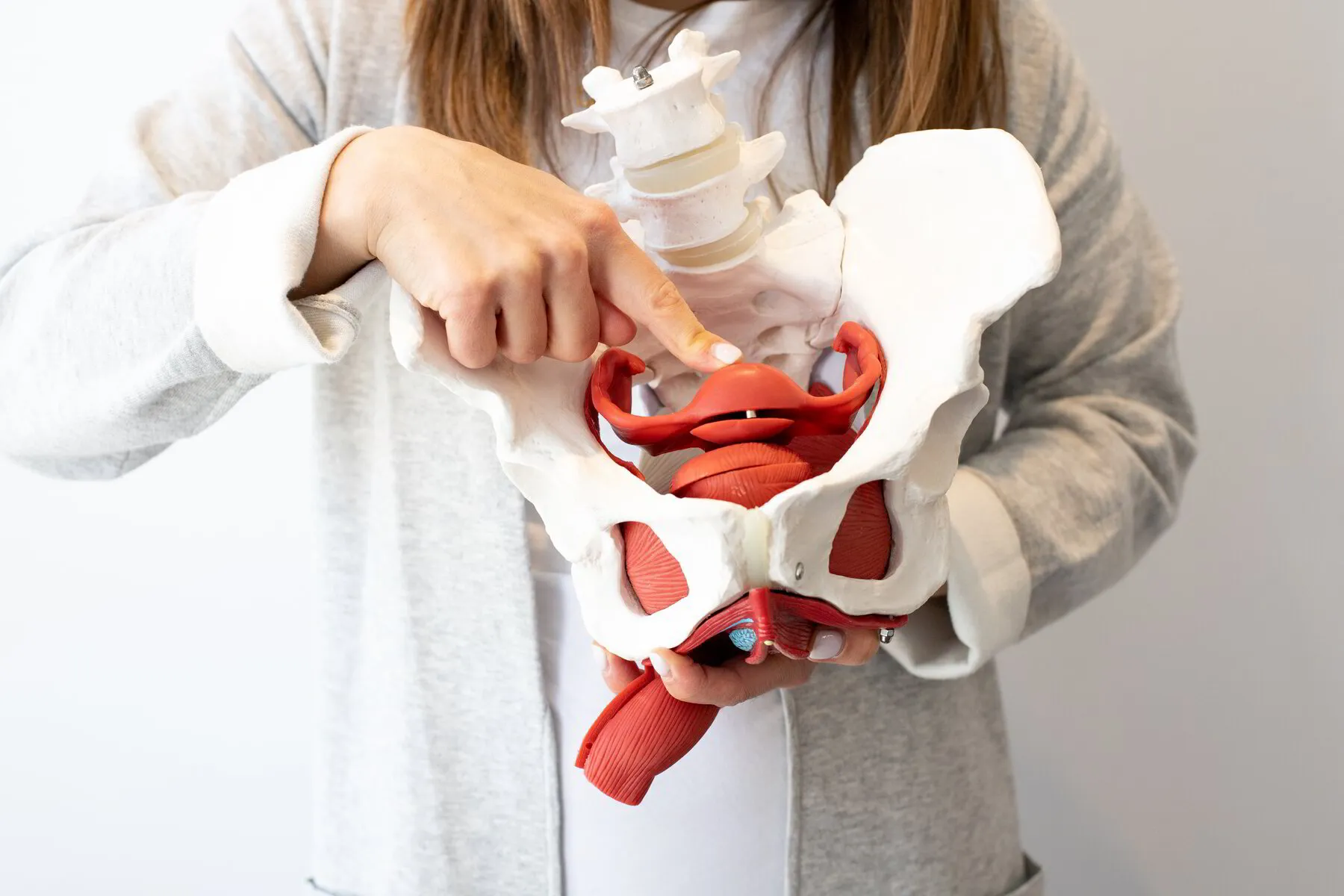
- A pelvic organ prolapse is when one or more the pelvic organs move downwards from their starting position and descend into the vagina. The pelvic organs being the uterus (called a uterine prolapse), the rectum (called a rectocele), bladder (called a cystocele) or urethra (urethrocele) or the top of the vagina (post hysterectomy, called a vaginal vault prolapse).[1]
- This generally happens when the pelvic floor, the muscles and other tissue supporting the pelvic organs become weakened, and overall less ‘functional’.[1]
- Symptoms of a prolapse are often reported as vaginal pressure or a feeling like something is coming outside of their vagina, often worse as the day goes on, or pelvic heaviness that becomes worse at the end of the day. Sometimes, depending on the type of prolapse, symptoms can include urinary leakage, and difficulty emptying their when peeing or pooing throughout the day.[1]
Next, let’s touch on how a POP is assessed
- A POP is assessed by beginning lying on your back, knees bent, with feet on the bed. Next, you would be asked to ‘prop’ up on your elbows which creates a downward pressure, and then further being asked to ‘push’ as hard as you can. Your health practitioner will then visualize whether there is any movement of the tissue and ‘grade’ a potential prolapse.[2]
- There are 4 stages of prolapse ranging from 0 (no prolapse) to 4. A stage 4 occurs when the organ is actually protruding outside of the vaginal opening, at rest, and would require surgical (and/or pessary, a supportive flexible device inserted vaginally) intervention.[1,2,8]
- It’s important to note that the majority of POP are not necessarily symptomatic, so sometimes having a practitioner assess for a prolapse and finding one can cause more fear and anxiety and potentially more symptoms due to the connection of such emotions to the pelvic floor![1]
How can we help support and ‘treat’ a POP?
The pelvic floor muscles are the muscles that support the pelvic organs, by attaching in the front at the pubic bone, side to side at the ‘sitz’ bones and at the tailbone in the back.[3]
Historically, the discussion about treating a prolapse has been to better support the pelvic organs by focusing just on strengthening the pelvic floor (i.e Kegels).[5] However, strength isn’t the only thing required for the pelvic floor to be functional- it needs to be flexible, be well- coordinated, have endurance, be able to turn on and off quickly (fast reps), in addition to strength.[4] So, there is much more to it than just doing a ‘Kegel’!!
We also have other muscles above the pelvic organs (our whole upper body) that need to help the pelvic floor, and can also impact a POP. We can’t just keep strengthening the pelvic floor and hoping that everything is healed if/when there are constant pressures and compensations happening from above, eg. gripping the upper abs, altered breathing patterns like breath holding. This will just keep creating pressure and load on the pelvic floor making it harder for it to work functionally.[6]
What you can do to help
- Make sure you are not straining on the toilet (it can weaken your pelvic floor)!! Get a stool (or books) that you can place under your feet to poo. It puts your pelvic floor muscles in a more lengthened position to make it easier, reducing the likelihood of straining.[7] This includes not straining/pushing pee out too! No just in case pees, or helping the pee come out quicker.
- Make sure to not breath hold! It will increase the pressure in your abdomen and in turn pressure on your pelvic floor, and vaginal walls. Make sure you are starting to exhale, breath out, just prior to doing anything that requires energy (like picking up kids, or heavy groceries, weights).[6]
- Modify any exercise or movements that increase the feeling of something falling outside of your vagina!
- Train your deep abdominal muscles
- See a Pelvic floor physiotherapist[5]
References
- American College of Obstetricians and Gynecologists. Pelvic organ prolapse: ACOG Practice Bulletin, Number 214. Obstet Gynecol. 2019;134(5):e126-e142. doi:10.1097/AOG.0000000000003519
- Bump RC, Mattiasson A, Bø K, et al. The standardization of terminology of female pelvic organ prolapse and pelvic floor dysfunction. Am J Obstet Gynecol. 1996;175(1):10-17. doi:10.1016/S0002-9378(96)70243-0
- Bordoni B, Sugumar K, Leslie SW. Anatomy, abdomen and pelvis: pelvic floor. In: StatPearls. StatPearls Publishing; 2026. Updated May 13, 2026. Accessed September 24, 2026. https://www.ncbi.nlm.nih.gov/books/NBK482200/
- Frawley H, Shelly B, Morin M, et al. An International Continence Society (ICS) report on the terminology for pelvic floor muscle assessment. Neurourol Urodyn. 2021;40(5):1217-1260. doi:10.1002/nau.24658
- Hagen S, Stark D, Glazener C, et al. Individualised pelvic floor muscle training in women with pelvic organ prolapse (POPPY): a multicentre randomised controlled trial. Lancet. 2014;383(9919):796-806. doi:10.1016/S0140-6736(13)61977-7
- Hodges PW, Sapsford R, Pengel LHM. Postural and respiratory functions of the pelvic floor muscles. Neurourol Urodyn. 2007;26(3):362-371. doi:10.1002/nau.20232
- Sakakibara R, Tsunoyama K, Hosoi H, et al. Influence of body position on defecation in humans. Low Urin Tract Symptoms. 2010;2(1):16-21. doi:10.1111/j.1757-5672.2009.00057.x
- Bugge C, Adams EJ, Gopinath D, et al. Pessaries (mechanical devices) for managing pelvic organ prolapse in women. Cochrane Database Syst Rev. 2020;11(11):CD004010. doi:10.1002/14651858.CD004010.pub4


